What Does Defilade Mean? Military Term & Game Context
Defilade explained: the military meaning, how it differs from enfilade, how to pronounce it, and why RBGames chose the term for a cover-driven modern RTS.
Primary search intent
defilade meaning
On this page +
Defilade is a military term for protection from enemy observation and fire, usually provided by terrain or an obstacle. A unit in defilade is hidden behind a ridge, a wall, a building or a trench lip, so the enemy cannot see it clearly or hit it directly.
It is not the same as being invisible, and it is not a magic shield. It is a relationship between a position, an observer and a line of sight.
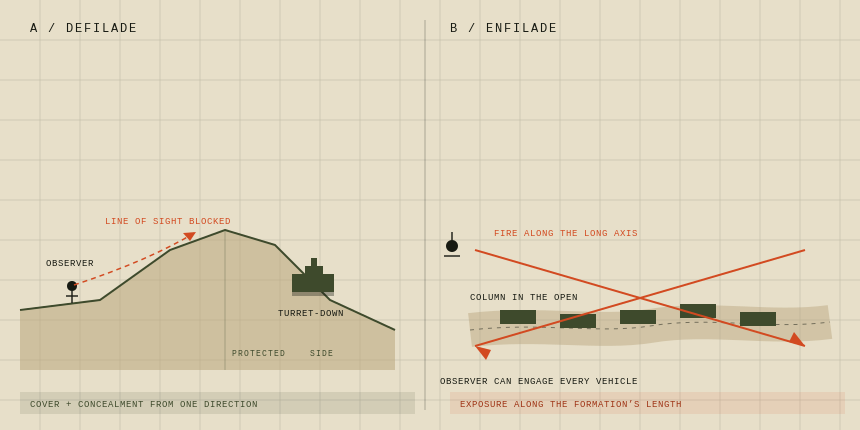
A / Defilade: the ridge blocks the observer’s line of sight. The tank is turret-down.
B / Enfilade: the column is exposed to fire along its length.
The simple definition
Merriam-Webster defines defilade as arranging fortifications so as to protect the lines from frontal or enfilading fire. In ordinary usage, a position “in defilade” is one that uses terrain or an obstacle to shield itself from enemy observation and direct fire.
The key words are observation and fire. Defilade is not just about stopping bullets. If the enemy cannot see you, they cannot aim at you. A reverse slope can protect a unit without a single sandbag.
A tank hull-down behind a ridge is the classic example. The hull is hidden; only the turret is exposed. The tank can still shoot, but most of its body is protected by the ground itself.
What enfilade means
Enfilade is the opposite relationship. Fire is directed along the longest axis of a formation or position. If a column of vehicles is moving down a road and the enemy is shooting from the side, the whole column is exposed in sequence.
The words come from French: enfiler, to thread or string together, and défiler, to slip away or file off. The concepts were named in English military usage during the Hundred Years’ War.
The practical difference:
- Defilade: the terrain breaks the line of sight. You are protected from a direction.
- Enfilade: the terrain does not break the line of fire, and the formation’s length works against it.
A trench can be in defilade from the front and in enfilade from the flank. That is why trenches are dug in zigzags rather than straight lines.
How to pronounce it
The common English pronunciation is DEF-ih-layd (IPA: /ˈdɛf.ɪ.leɪd/). Merriam-Webster gives \ˈde-fə-ˌlād. Some speakers stress the second syllable; both are heard. The word is not “dee-FIL-ade.”
Why the game is called Defilade
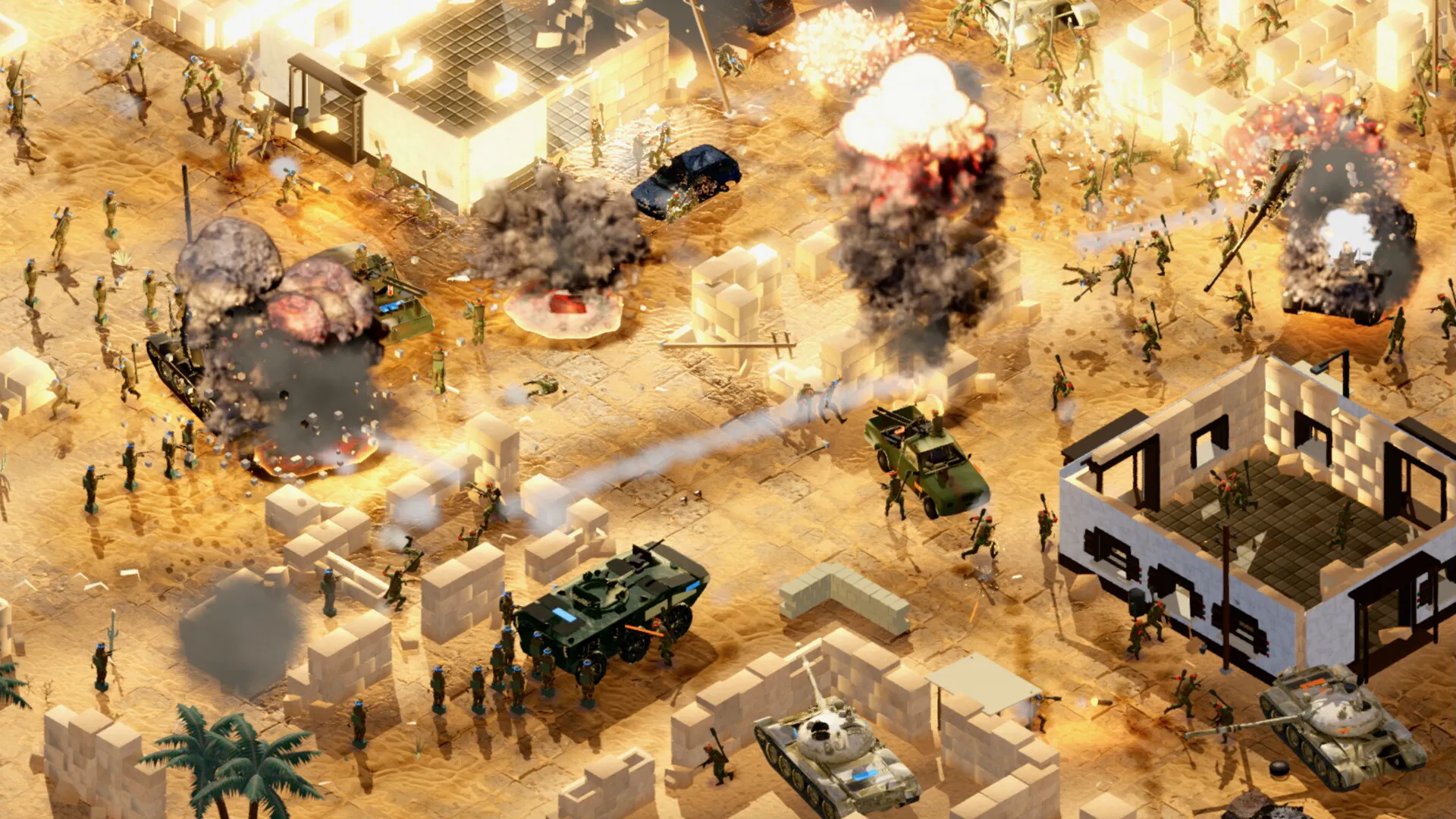
The title is a statement of design intent. RBGames is building an RTS where cover is not a binary modifier but a relationship between a soldier, a piece of geometry and a line of fire.
That shows up in the confirmed systems:
- Soldiers use walls, corners, trenches, vehicles, trees and wreckage as cover.
- They change posture and blind-fire around corners.
- Tanks can be dug in so only the turret shows — the game’s most literal defilade.
- Trenches have walls and corners, so a position can be protected from one angle and exposed from another.
- Buildings collapse, which changes the geometry and therefore the cover.
The title also signals what the game is not. It is not a game about standing in the open and trading hit points. It is about making the terrain do work for you.
Defilade is not “cover” in the video-game sense
In most shooters, “cover” is a tagged object that grants a damage reduction. Defilade is broader:
- A ridge that blocks observation is defilade even if there is no physical barrier.
- A building that hides a unit is defilade, until it is destroyed.
- A trench is defilade from the front and a trap from the flank.
- Smoke can conceal, but it does not stop a bullet.
That is why the game’s cover system has to read geometry rather than snap to cover nodes. The term is doing real design work.
Common misconceptions
- “Defilade means invisible.” No. It means shielded from observation and fire along a line of sight. A drone overhead may still see you.
- “Defilade is just a trench.” A trench is one way to achieve it. A reverse slope, a building, a vehicle hull or a ridge can all do the job.
- “Enfilade is the same as flanking.” Related, but not identical. Enfilade is fire along the long axis; flanking is attacking the side. A flank attack can produce enfilade fire.
- “The game is a military simulation.” It is an RTS inspired by classic base-building games and modern warfare. The title is a concept, not a promise of simulation-grade ballistics.
Further reading
For the game’s cover behaviour, read the cover system guide. For the units that benefit most from terrain, see the Leopard 2A4 and T-90 dossiers. For the broader design, start with the game overview.