Defilade vs Company of Heroes: Key Differences Explained
How Defilade compares with Company of Heroes: squad AI, cover, base building, supply, destruction, scale and campaign structure — without claiming a winner.
Primary search intent
Defilade vs Company of Heroes
On this page +
Defilade is unreleased. This page compares the announced design with Company of Heroes as a reference point. It does not claim that Defilade is better, worse, or a direct replacement.
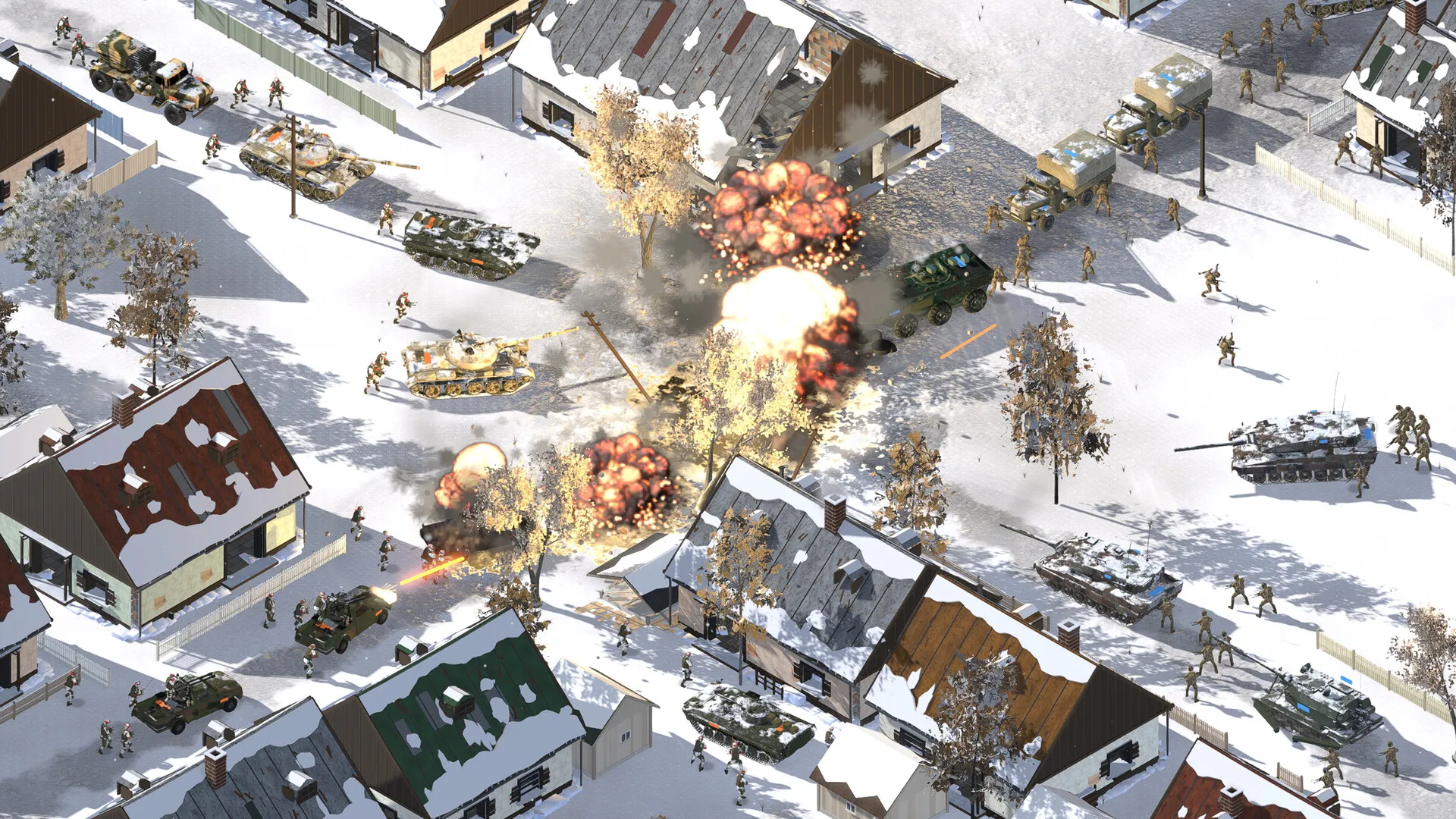
Defilade is often described as “Company of Heroes meets Red Alert” or “a modern Sudden Strike.” The comparisons are useful, but they can mislead. Defilade shares Company of Heroes’ interest in cover and squad behaviour, and it shares Red Alert’s interest in base building and a visible army. The combination is not the same game as either.
Here is the honest comparison, limited to what RBGames has published.
The short version
| Question | Company of Heroes | Defilade (announced) |
|---|---|---|
| Scale | Tactical company-level combat | Large battles; developer reports a unit cap around 100 per side |
| Base building | Yes, but comparatively compact | Old-school base building with FOBs, factories, research, helipads |
| Cover | Directional cover, suppression, squad weapons | Geometry-aware soldier AI, posture, blind fire, destructible cover |
| Logistics | Reinforcements and resource points | Physical supply trucks, roads, ammunition, manpower |
| Destruction | Destructible environment in places | Fully destructible battlefields advertised; bridges, buildings, debris |
| Campaign | Scripted mission campaigns | Planned grand campaign with persistent named soldiers and permadeath |
| Air/drones | Limited air support | FPV drones, attack/transport helicopters, B-52, anti-air, tactical nuke |
| Tone | Cinematic WWII | Modern warfare, fictional West/East/Rebel conflict |
The table is a map of design priorities, not a feature score.
Cover: squad-level versus soldier-level
Company of Heroes made directional cover a genre staple. A squad behind a wall gets protection from that direction; flank it and the cover fails. Suppression pins units and forces them to move.
Defilade pushes the same idea down to the individual soldier. The claim is that almost any object can be cover, that soldiers choose posture and position, and that they fight around corners and from trench walls. The 22 October update adds motion-captured animations for walls, corners and trenches, plus blind fire and grenade dives.
That is more granular, but granularity is not automatically better. Company of Heroes’ cover is readable because it is abstracted into clear states. Defilade’s cover may be more realistic and harder to read. The demo will decide whether the animation sells a system the player can trust.
Base building: old-school versus tactical
Company of Heroes has base building, but its economy is driven by capture points and its build options are relatively compact. Defilade is explicitly old-school: a forward operating base, a factory, a research building, helipads and a visible build radius. The developer cites Red Alert and Sudden Strike as inspirations.
That means a different rhythm. You are not only fighting for the next capture point; you are building the infrastructure that produces the next wave. The base is a physical target, and the supply road is part of the strategy.
Logistics: the biggest difference
Company of Heroes abstracts reinforcement and resource income. Defilade is trying to make supply physical: trucks move resources and ammunition along roads, and the AI commander guards its own convoys while raiding yours.
If it works, it creates a second battlefield behind the front. If it does not, it becomes routine housekeeping. The published material is clear about the intent but not about the tuning.
Destruction: systemic versus set-piece
Company of Heroes uses destruction as a tactical and cinematic tool: buildings collapse, craters appear, cover changes. Defilade advertises fully destructible battlefields, with walls breaking at impact points, floors collapsing, debris becoming cover and bridges falling into rivers.
The difference is one of degree. Defilade’s claim is closer to a systemic destruction model than a set-piece. The technical risk is performance, especially on the published minimum specification.
Campaign: the biggest unknown
Company of Heroes is built around a scripted campaign. Defilade plans a grand campaign on one large fictional map, with two superpowers fighting a proxy war and named soldiers who level up and can die permanently.
That is a promise for the full version, not a confirmed Early Access feature. The Early Access launch is planned around five modes: Skirmish RTS, Frontlines, Squads, Search and Destroy and Defend. A campaign is planned for the finished game.
What Defilade is not
- Not a Company of Heroes replacement. It has base building, a larger unit cap and a modern setting. The tactical feel may be different.
- Not a pure tactics game. The base and logistics layers are central.
- Not a milsim. It uses real vehicle names and modern equipment, but the developer is building an RTS, not a simulation.
- Not a finished game. Every comparison is against an announced design.
Who might prefer which
Company of Heroes may suit you if: you want a tightly designed, cinematic tactical game with a proven campaign and a clear cover language.
Defilade may suit you if: you want old-school base building, large battles, physical logistics, modern drones and air power, and you are interested in a game where the infantry AI is the main event.
Wait for the demo if: you are unsure. The demo arrives on 1 December, two weeks before Early Access. It will answer more than any comparison can.
For the game’s own design, read the systems manual and the game overview. For the release status, see the situation report.